
Most traders look for reversals by hunting for the lowest price. Experienced traders wait for something far more reliable — failure of the existing trend.
The Nifty IT index provides a textbook example of how EMA, when read in the right context, can help identify a genuine trend transition instead of emotional counter-trend trades.
This case study is not about predicting the bottom. It is about reading what the market is failing to do.
EMA Power in a Trending Market
EMA is often misunderstood as a crossover or signal-generating indicator. In reality, in a trending market, EMA works best as a decision zone, not a trigger.
When the market is trending down, EMA acts as a selling area. Price pulls back into this zone, sellers step in again, and the market attempts to print a fresh low. In an uptrend, the same EMA behaves as a buying area, offering pullback opportunities before the next leg higher.
The key idea is simple: trade in the direction of the trend and wait for continuation in the form of a new high or a new low. If that continuation does not happen, the story starts changing.
This is where Pivot-based EMA (PEMA) adds clarity, as it aligns EMA behavior with higher-timeframe structure rather than treating it as a fast-moving line.
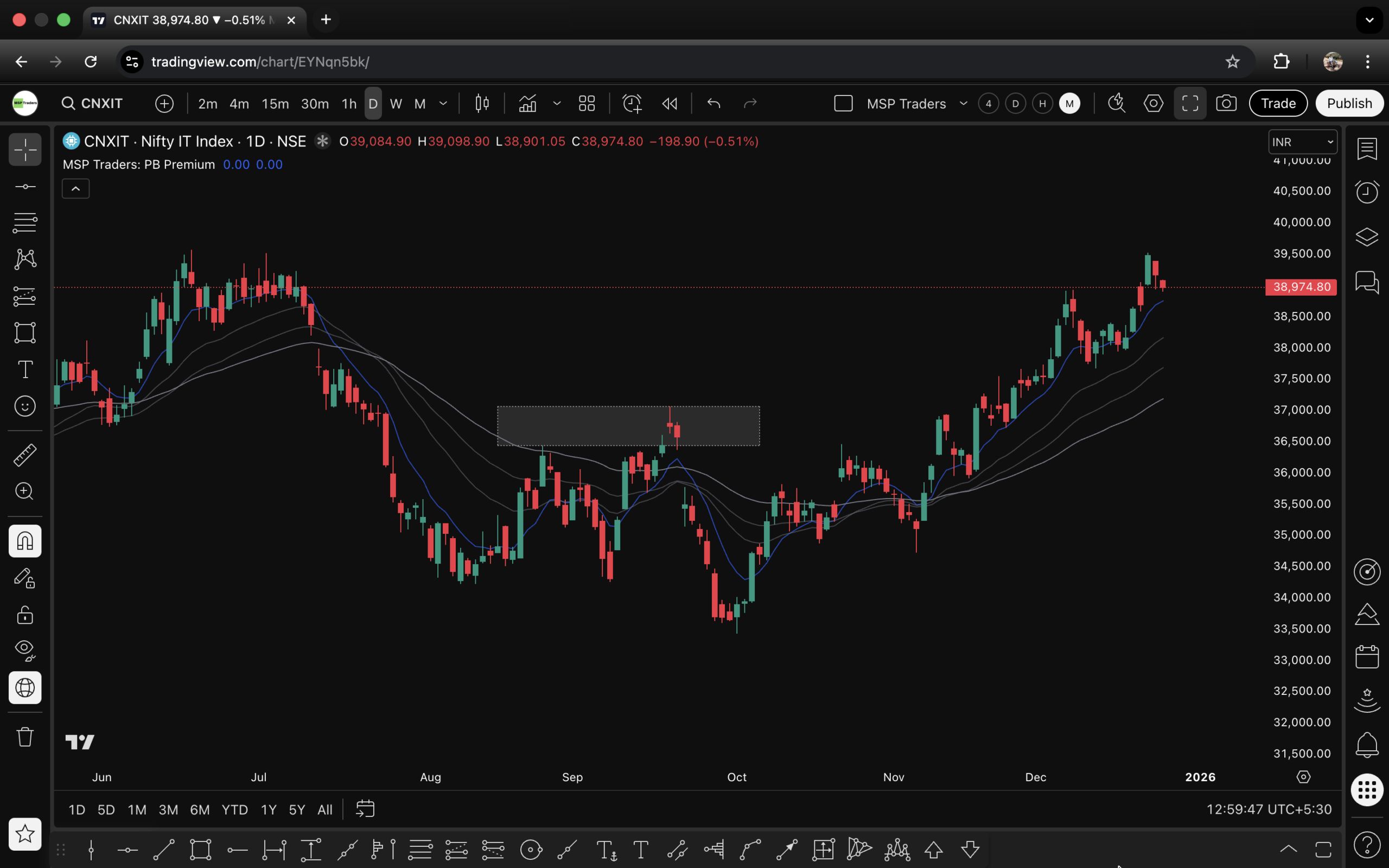
August: Pullback Into PEMA and the Short Bias
In August, Nifty IT was clearly in a downtrend. The structure showed lower highs and lower lows, and momentum favored the sellers. Price pulled back into the PEMA zone, which is exactly how trending markets behave before continuing lower.
At this stage, this pullback was not a warning sign. It was an opportunity. In a falling market, pullbacks into EMA or PEMA are classic areas where sellers re-enter. The only expectation after such a pullback is straightforward — price should go on to make a new low.
This was a clean short-side environment, not because of any candle pattern, but because market structure supported it.
September: Failure to Make a New Low
September changed the tone. After the earlier pullback and selling attempt, price failed to make a meaningful new low. This is a critical observation.
A strong downtrend should have no difficulty pushing to fresh lows. When it cannot do that, it signals that selling pressure is weakening and buyers are beginning to absorb supply.
However, this is where most traders make a mistake. A failed low does not automatically mean “buy.” It only means the downtrend is under stress. At this point, patience matters more than action.
The Double Top Trap in September
Instead of reversing immediately, price formed a double-top-like structure in September. From a structural perspective, this was a bearish attempt to resume the downtrend.
This phase often traps early bulls. The market appears weak again, convincing traders that the downtrend will continue. In reality, this is usually the market’s way of testing whether sellers still have strength.
Bias during this phase should remain cautious. The market is deciding, not confirming.
October: New Low That Failed to Hold
October delivered the confirmation that September did not. Price managed to make a new low, but this time it failed to hold below it. The rejection from lower levels was sharp and meaningful.
This behavior is very different from a healthy downtrend. When a market breaks to a new low and immediately finds strong buying interest, it is no longer a seller-controlled environment. This is the moment where control starts shifting.
This is the point where the trend changes. Not because price is cheap, but because sellers have lost their ability to push price lower.
From here, EMA stops acting as a selling zone and begins transitioning into support over time.
What This Case Study Teaches
The Nifty IT reversal highlights a simple but powerful truth: trends end when they fail to continue, not when indicators show oversold readings.
EMA do not predict reversals. They help you frame expectations. When those expectations repeatedly fail, the market is giving you information — if you are willing to listen.
Learn More About PEMA
To understand how EMA improves trend clarity and structural alignment, you can explore it in detail here: PEMA – Pivot Based EMA: The Fast-Momentum Moving Average System Every Trader Should Learn
Final Thoughts
Reversals are not single-day events. They unfold in phases — pullback, failure, trap, and finally rejection. The Nifty IT index followed this script perfectly.
If you stop chasing bottoms and start studying failures, the market becomes much easier to read.
Cheers !!
Arup MSP
Creator of Pivot Mastery (The Practical Way to Understand Market Context)
Social Profiles:
Follow on X
Follow on Facebook